
Technical Name: SAFETY IN PRE-SHIPMENT OPERATION TRAINING COURSE NR 37 – SAFETY AND HEALTH ON OIL PLATAFORMS
Reference: 172617
We provide courses and training; We perform Translations and Versions in Technical Language: Portuguese, English, Spanish, French, Italian, Mandarin, German, Russian, Swedish, Dutch, Hindi, Japanese and others consult.
Pre-Boarding Course English
The Pre-Boarding Course English aims to prepare workers to recognize, evaluate and control offshore operational risks with accuracy and confidence. Through structured theoretical guidance, participants learn how to interpret working conditions, understand environmental and chemical hazards and identify ignition sources present on oil platforms. As they progress, they gain the ability to anticipate unsafe scenarios and apply protective measures that align with real offshore demands.
Additionally, the training ensures that every participant understands and correctly applies the requirements established by NR 37. By integrating its provisions into each topic, the course strengthens decision-making under pressure and enhances situational awareness before boarding. Consequently, workers develop a solid foundation for safe access, effective use of protective systems and competent response to emergency situations.

Crew members verify equipment integrity and communication routines, ensuring full compliance with offshore safety requirements before departure.
Who is responsible for ensuring safe access procedures before boarding an offshore platform?
The responsibility for safe access begins with the worker receiving proper training and demonstrating full understanding of NR 37 requirements. As the course progresses, participants learn to apply access protocols proactively, reducing exposure to instability, hazardous atmospheres and mechanical movement zones.
At the same time, the operational team onshore maintains the duty to verify conditions, authorize boarding and communicate restrictions. This dual responsibility creates a structured flow of accountability, which strengthens consistency in decision-making and ensures that risk controls remain active from the first moment of transit.
When should risk-control measures be verified during pre-shipment operations?
To ensure consistency and precision in offshore preparation, the worker must verify risk-control measures at strategic moments that directly influence operational safety. Since conditions shift quickly during the transition from land to sea, each verification point serves as a safeguard that stabilizes judgment, reduces uncertainty and aligns actions with best practices required under NR 37. The table below structures these moments clearly so the process becomes predictable and repeatable.
| Verification Moment | Required Focus Area |
|---|---|
| Before accessing transport | Environmental and operational stability |
| Upon arriving at boarding gate | Communication signals and pathway conditions |
| Before stepping onto the platform | Ignition sources and atmospheric status |
| During initial circulation offshore | EPC availability and emergency routes |
| After settling in operational zones | PPE effectiveness and exposure risks |
Pre-Boarding Course English: The identification of flammable substances is essential before boarding the platform.
Understanding the presence and behavior of flammable substances is a decisive factor for safe offshore operations. Because these agents react quickly to ignition sources and environmental variations, workers must internalize this statement as a non-negotiable operational truth. The following elements highlight the core aspects that shape this essential competency.
Identification of stored fuels
Classification of vapor pressure levels
Recognition of explosive limits
Assessment of container integrity
Review of MSDS requirements
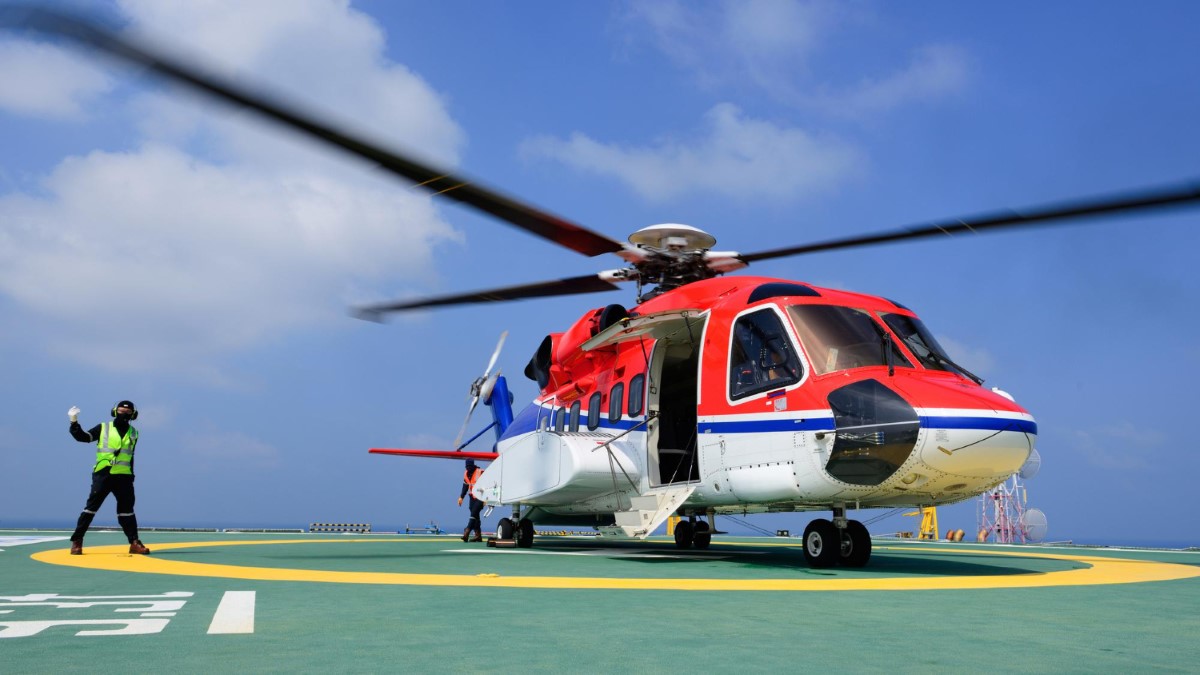
Clear guidance on the helideck ensures safe aircraft positioning and controlled passenger movement during offshore boarding procedures.
Why do offshore environmental conditions require continuous awareness during pre-shipment procedures?
Environmental factors change rapidly offshore, and these variations directly affect worker safety. Sudden shifts in wind direction, temperature gradients and atmospheric pressure can alter gas movement, visibility or access routes. Because these conditions influence operational routines, workers must approach them with real-time attention and readiness to adjust decisions.
In addition, NR 37 highlights the necessity of monitoring environmental risks because offshore areas behave differently from terrestrial environments. This awareness strengthens hazard recognition and supports accurate interpretation of early warning signs. As workers incorporate these observations into their behavior, they create a safer transition from land to platform operations.
Where should safety data about chemicals and hazardous materials be consulted before initial offshore activities?
Accessing chemical safety data in the correct locations ensures that workers understand the properties, incompatibilities and operational restrictions associated with hazardous materials. Since these substances behave differently under offshore conditions, the ability to consult accurate information strengthens decision-making and prevents procedural errors. The table organizes these consultation points to support clarity and immediate application.
| Consultation Point | Information Contained |
|---|---|
| Onshore safety office | Chemical inventory and hazard classification |
| Electronic MSDS database | Handling precautions and incompatibilities |
| Platform documentation repository | Site-specific controls and emergency protocols |
| Supervisory briefing files | Operational limits and updated restrictions |
Pre-Boarding Course English: Emergency procedures must be clearly understood prior to boarding
Emergency response offshore demands immediate clarity because reaction time dictates survivability. When workers internalize procedures before boarding, they reduce hesitation, sharpen situational awareness and maintain operational flow even under distress. To reinforce this priority, the foundational components below highlight the elements that must be mastered in advance.
Recognition of alarm tones
Identification of escape routes
Use of collective protection systems
Activation sequence for incident communication
Assembly point expectations
What factors determine the safe movement of workers during the first minutes on the platform?
Movement safety depends on accurate interpretation of operational cues and environmental elements during the early stages of familiarization. Workers must understand how lighting, noise levels, structural layout and atmospheric conditions influence navigation. This early situational awareness guides confident decisions and prevents exposure to unexpected hazards.
In addition, NR 37 reinforces the need to evaluate ignition sources, access pathways and proximity to hazardous areas immediately upon arrival. By practicing this assessment from the first steps on deck, workers begin their activities with a stronger operational mindset. This proactive behavior reduces incidents associated with disorientation, distraction or failure to recognize active risks.

Pre-boarding inspections and ground signals support hazard identification and reinforce flight safety prior to transport to the platform.
What is the importance of the Pre-Boarding Course English?
The Pre-Boarding Course English holds significant importance because it strengthens the worker’s ability to anticipate, interpret and control offshore operational risks before the first contact with the platform. By understanding environmental conditions, chemical hazards, ignition sources and the behavioral dynamics of atmospheric changes, participants develop a higher level of situational awareness. This preparation reduces uncertainty during boarding, promotes safer decision-making and ensures that actions taken in the early minutes offshore follow a structured logic grounded in professional safety practice.
Furthermore, the training becomes essential because it aligns every procedure with the requirements established by NR 37. As the course integrates its provisions into each topic, workers learn to apply regulatory criteria with consistency, enhancing operational discipline and reducing exposure to preventable hazards. Consequently, the program elevates both individual readiness and collective protection, reinforcing the safety culture expected in offshore operations.
Click the Link: Criteria for Issuing Certificates according to the Standards
Certificate of completion
NR 37 PRE-BOARDING COURSE IN ENGLISH
Technical Name: SAFETY IN PRE-SHIPMENT OPERATION TRAINING COURSE NR 37 – SAFETY AND HEALTH ON OIL PLATAFORMS
Total Duration: 06 Hours
Module 01 – Access Means and Boarding Procedures (01 Hour)
Identification of access systems to offshore platforms
Mandatory safe-boarding protocols
Initial circulation procedures and safety conduct
Communication requirements upon entering operational areas
Preliminary assessment of the environment after access
Module 02 – Working Conditions and Offshore Environment (01 Hour)
Operational characteristics of offshore platforms
Environmental factors that influence daily activities
Exposure conditions and task-related constraints
Human-factor considerations in isolated offshore settings
Interaction between environment, equipment and operational routines
Module 03 – Combustible and Flammable Substances Onboard (01 Hour)
Characteristics and physical properties of onboard combustible agents
Fire behavior, ignition potential and risk escalation
Identification of hazardous atmospheres
Controls applied to flammable and explosive substances
Preventive measures for handling, storage and monitoring
Module 04 – Classified Areas, Ignition Sources and Control Measures (01 Hour)
Definition and categorization of classified areas
Common ignition sources in offshore operations
Techniques for controlling ignition and preventing escalation
Safe work practices in electrically classified zones
Monitoring strategies for maintaining atmospheric stability
Module 05 – Environmental, Operational and Psychosocial Risks (01 Hour)
Environmental risks present in the offshore perimeter
Operational hazards inherent to specific work activities
Psychosocial stressors such as extended shifts and night work
Effects of stressors on performance and health
Preventive and mitigation measures for each risk group
Module 06 – Hazardous Materials, Protection Systems and Emergency Procedures (01 Hour)
Hazardous chemicals and explosives handled or stored onboard
Interpretation and application of Material Safety Data Sheets – MSDS
Collective Protection Equipment – EPC: functions and limitations
Personal Protective Equipment – PPE: selection and correct use
Emergency procedures and response protocols for incident scenarios
Completion and Certification:
Practical Exercises (when contracted);
Evidence Recording;
Theoretical Evaluation;
Practical Evaluation (when contracted);
Certificate of Participation.
NOTE:
We emphasize that the General Normative Program Content of the Course or Training may be changed, updated, with items added or removed as necessary by our Multidisciplinary Team. Our Multidisciplinary Team is authorized to update, adjust, modify and/or remove items, as well as insert or remove Standards, Laws, Decrees or technical parameters they deem applicable, whether related or not, and the Contracting Party is responsible for complying with the requirements set forth in the relevant Legislation.
NR 37 PRE-BOARDING COURSE IN ENGLISH