Technical Name: USE OF BOSUN CHAIR NR 18 COURSE (INDIVIDUAL ROCKER)
Reference: 171053
We provide courses and training; We perform Translations and Versions in Technical Language: Portuguese, English, Spanish, French, Italian, Mandarin, German, Russian, Swedish, Dutch, Hindi, Japanese and others consult.
Suspended Chair Course English
The Suspended Chair Course English aims to develop the participant’s ability to operate a manual suspended chair with precision, stability and full situational awareness during work-at-height activities. Throughout the training, the learner understands how to evaluate the integrity of support lines, verify anchorage conditions, recognize structural limitations and correctly apply safety devices such as descent systems, connectors and fall arrest components. This approach strengthens technical decision making and ensures the equipment functions within the operational limits defined by NR 18, the primary regulatory framework for suspended access systems in the construction industry.
In addition, the course trains the worker to identify hazards, interpret mechanical resistance data, and perform pre-use inspections that prevent equipment failure. By applying transitional reasoning between risk assessment, system configuration and emergency readiness, the participant learns to maintain a continuous safety mindset while managing dynamic loads and environmental variables. As a result, the professional becomes capable of performing suspended tasks with consistent control, regulatory compliance and technical confidence aligned with the requirements established by NR 18.
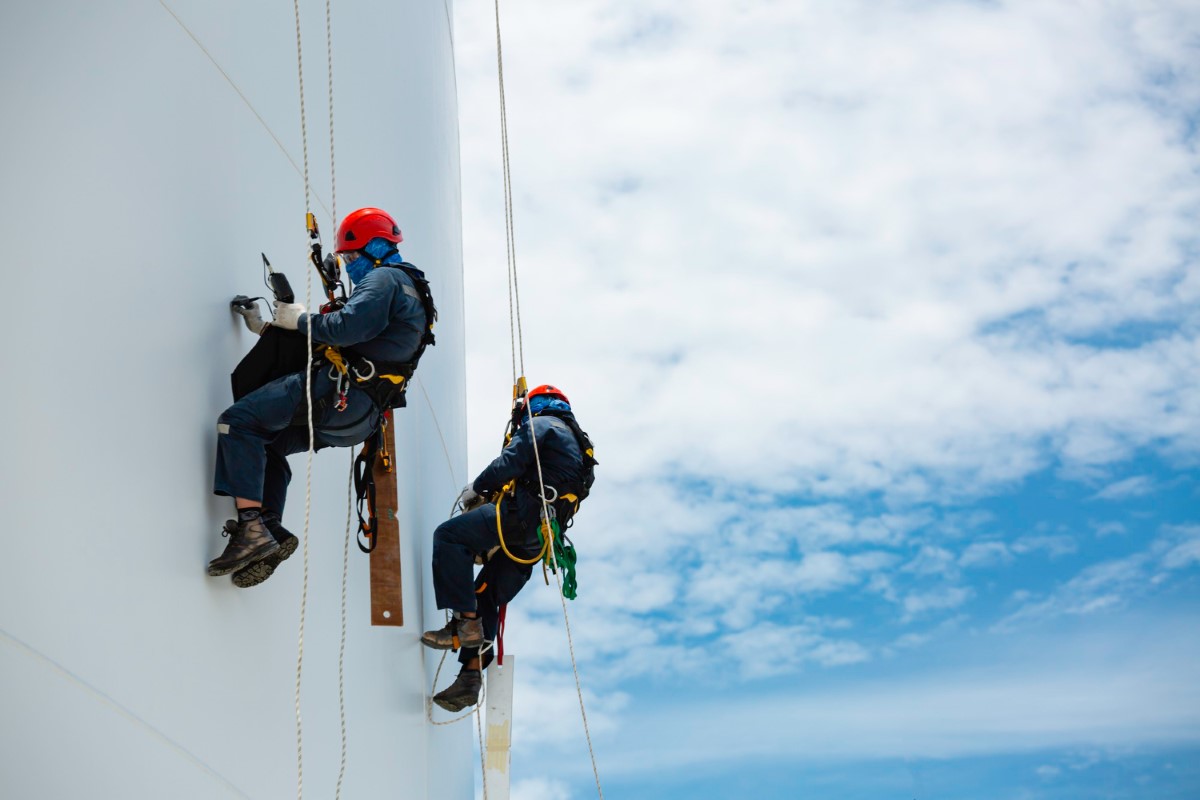
Two height professionals conduct structural inspection on vertical surfaces, demonstrating coordinated movement and secure positioning in compliance with NR 18.
Who is qualified to operate a bosun chair under NR 18 requirements?
Workers qualified to operate a bosun chair must complete structured training that integrates equipment analysis, descent control, anchorage verification and the interpretation of mechanical resistance criteria. NR 18 requires operators to understand how suspended systems behave under load, recognize instability patterns, assess environmental influences and apply protective equipment correctly. This ensures that every action follows a regulated safety logic that minimizes exposure to fall hazards and strengthens operational precision.
Workers must also demonstrate the ability to detect wear, evaluate compatibility between components and identify deviations before they escalate into structural failures. When the participant masterfully connects NR 18 principles to practical risk management, they operate the suspended system with confidence, control and technical consistency.
When should the support line and structural components be inspected according to NR 18?
Inspection routines determine whether the system remains structurally reliable, and NR 18 emphasizes proactive monitoring to prevent degradation from becoming a hidden threat. Because suspended operations depend on mechanical resistance, workers must verify line conditions, connector integrity and device performance before, during and after each activity. These inspections ensure predictable load distribution, prevent unexpected slippage and maintain compliance with regulatory safety factors.
| Inspection Moment | Technical Requirement | Purpose |
|---|---|---|
| Before each use | Visual and tactile inspection of cables and connectors | Detect early wear or incompatibility |
| During operation | Monitoring tension, movement and descent behavior | Ensure correct response under load |
| After use | Checking for deformation, abrasion or chemical attack | Determine corrective maintenance |
| Periodic schedule | Inspection by a qualified professional | Validate structural integrity per NR 18 |
Suspended Chair Course English: Proper anchorage selection is essential
Anchorage selection defines the reliability of the entire suspended access system, and NR 18 reinforces that no component compensates for a weak or inadequate anchor point. Because fall-arrest forces multiply during dynamic movement, the anchorage must withstand extreme conditions while maintaining structural predictability. This requires precise evaluation of load paths, surface stability, environmental influences and certification standards that ensure consistent performance across different scenarios.
Correct structural analysis
Compatibility with certified anchorage devices
Minimum load resistance as defined by standards
Verification of environmental and dynamic stress factors
Documentation and traceability of anchorage equipment
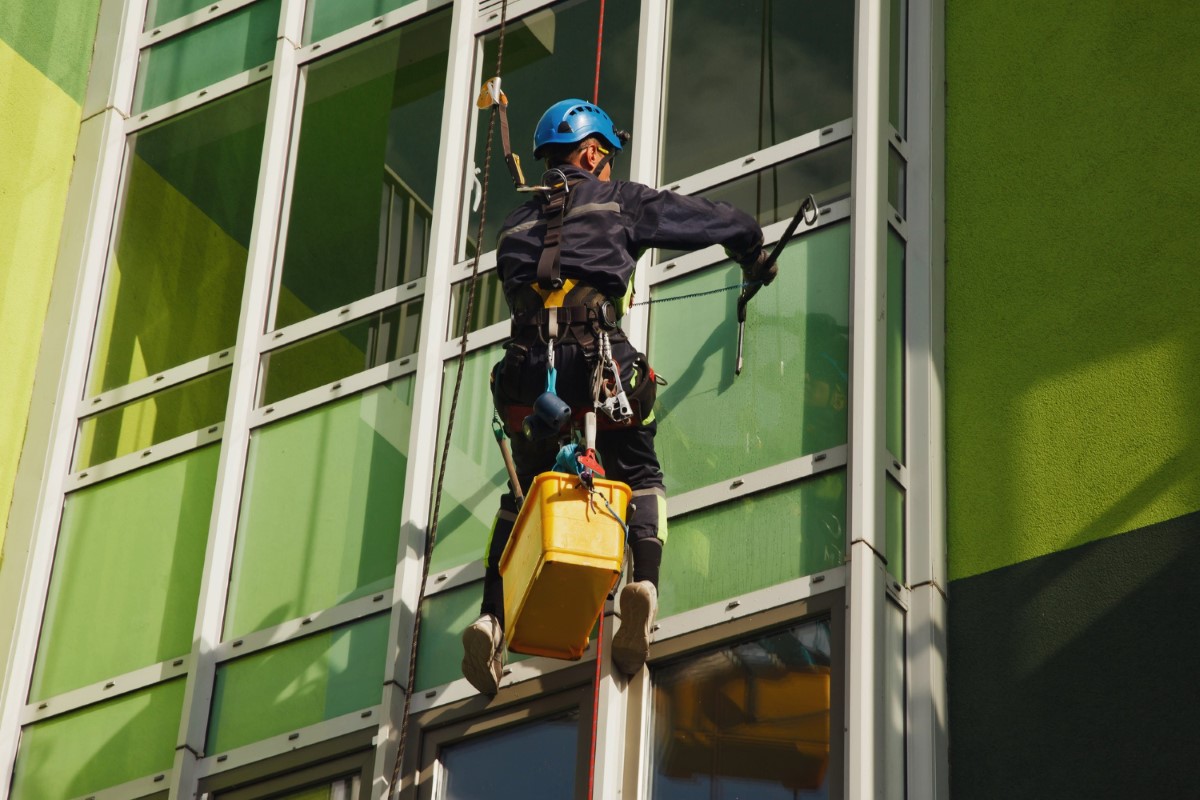
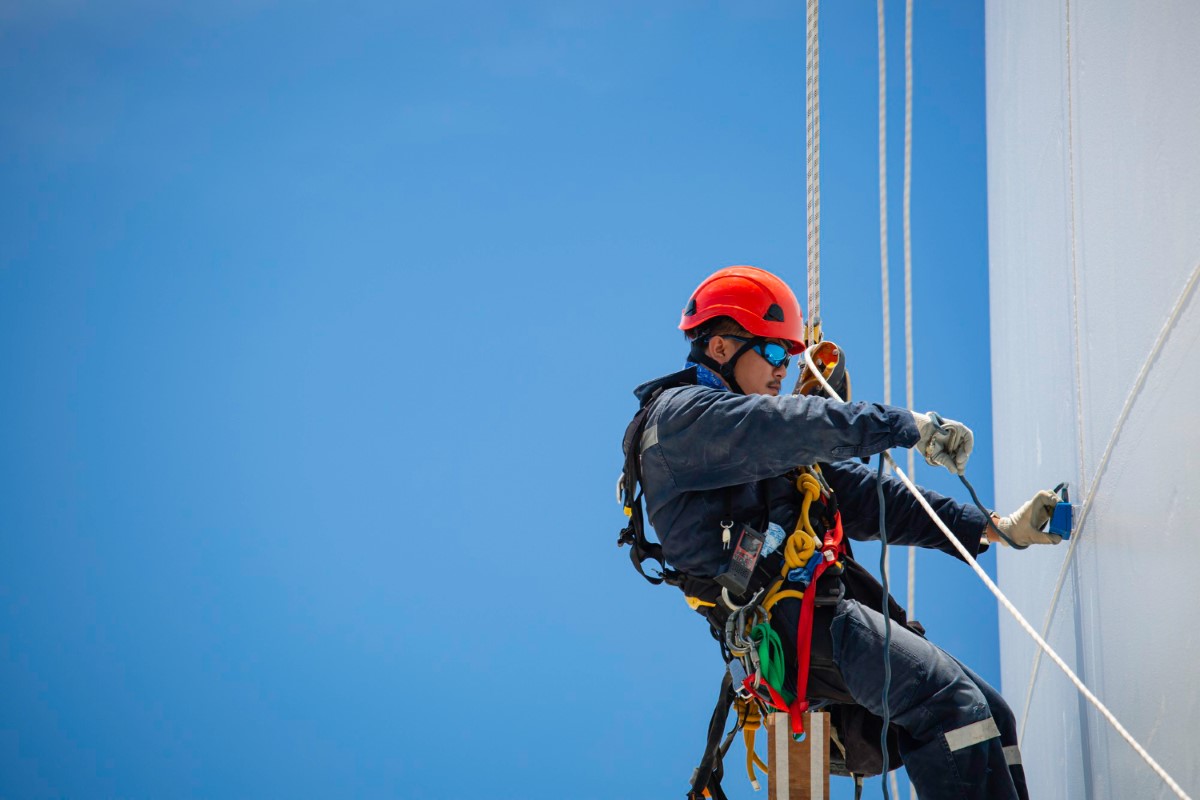
Worker operates a bosun chair while performing façade maintenance, maintaining full control of descent and anchorage stability according to NR 18 requirements.
Why does NR 18 require dynamic performance testing for safety locks?
NR 18 requires dynamic performance testing because safety locks must react instantly to abrupt changes in velocity that simulate real fall events. Static tests alone cannot capture the rapid acceleration forces that occur during a slip or uncontrolled descent, so the standard mandates evaluations that expose the device to realistic impact loads. These tests verify whether the lock engages at the correct threshold, prevents excessive free fall and maintains structural integrity throughout repeated cycles.
Furthermore, dynamic testing ensures that the internal mechanisms continue to perform consistently under stress, which is essential for predictable behavior during real operations. This approach reduces the chance of mechanical failure, strengthens the reliability of the system and enhances the worker’s ability to operate safely under NR 18 compliance.
What are the main differences between steel cable and synthetic fiber cable in suspended access?
Choosing between steel cable and synthetic fiber cable requires analyzing how each material responds to environmental exposure, abrasion, bending cycles and dynamic load events. Because suspended operations depend on predictable friction, compatibility with descent devices and stable tension distribution, selecting the correct support line influences both safety and operational efficiency. NR 18 reinforces that the chosen cable must sustain required break loads, perform consistently under stress and align with the equipment manufacturer’s specifications.
| Feature | Steel Cable | Synthetic Fiber Cable |
|---|---|---|
| Weight | Heavier | Lighter |
| Flexibility | Low | High |
| Corrosion Resistance | Requires protection | Excellent resistance |
| Abrasion Resistance | Very high | Moderate |
| Compatibility with Devices | Strict | More adaptable |
| Maintenance | More frequent | Less frequent |
Suspended Chair Course English: Descent technique requires precision
Safe descent relies on the operator’s ability to control friction, maintain body alignment and monitor the interaction between device and rope in real time. Because suspended access involves continuous load transfer, environmental variation and potential oscillation, the descent technique must integrate mechanical understanding with situational awareness. NR 18 emphasizes that workers must manage speed, evaluate device performance and ensure system compatibility to prevent uncontrolled movement.
Controlled friction management
Stable body positioning
Monitoring descent speed
Checking device compatibility
Maintaining communication during descent
Where should a bosun chair training program focus to ensure full technical competence?
A complete bosun chair training program must focus on equipment behavior, mechanical resistance, anchorage evaluation and the operational logic required for safe suspended work. By connecting NR 18 requirements to real-world scenarios, training strengthens the participant’s decision-making and develops the ability to interpret system reactions under load. This structure ensures that workers understand not only the equipment but the conditions that influence performance.
The program must also prioritize hazard recognition, inspection routines, environmental assessment and the correct application of fall protection systems. When these elements combine with structured risk management strategies, the worker becomes capable of performing vertical activities with confidence, control and regulatory precision.
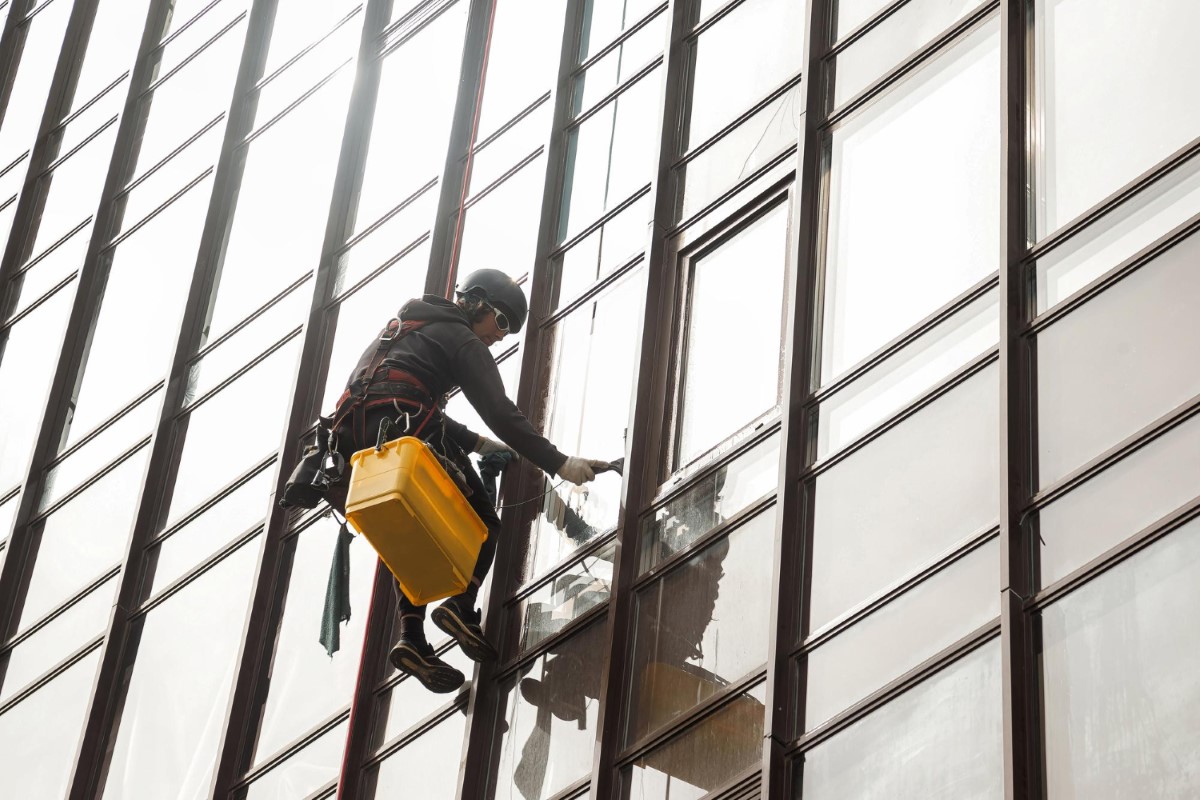
Suspended access technician executes window cleaning using a manual bosun chair, applying safe load distribution and continuous rope management.
What is the importance of the Suspended Chair Course English?
The Suspended Chair Course English is important because it prepares the worker to operate suspended access systems with technical precision, structural awareness and full regulatory alignment. By understanding how mechanical resistance, anchorage integrity and load transfer behave under real working conditions, the participant develops the ability to prevent instability, equipment failure and fall-related incidents. This technical maturity ensures that each action follows the performance and safety requirements established by NR 18, the primary standard governing suspended work equipment in the construction industry.
The course is also essential because it strengthens risk perception, inspection capability and decision making in situations where vertical movement depends on stable behavior of cables, connectors and descent devices. As the training integrates environmental assessment, equipment compatibility and emergency readiness, the worker gains operational confidence and performs tasks with higher efficiency and safety. Ultimately, the program elevates technical competence and minimizes exposure to hazards, ensuring compliance with NR 18 and reinforcing safe suspended access practices.
Click the Link: Criteria for Issuing Certificates in accordance with the Standards
Certificate of completion
Bosun Chair NR 18 Course
USE OF BOSUN CHAIR NR 18 COURSE (INDIVIDUAL ROCKER)
Course Load: 16 Hours
Module 01 – Terms and Definitions (1 Hour)
Key terminology for suspended access systems
Definitions of chair components and safety devices
Static and dynamic load concepts
Module 02 – Regulatory Requirements Under NR 18 (2 Hours)
Mandatory compliance structure
Technical responsibilities and documentation
Inspection frequency and safety controls
Module 03 – Design, Ergonomics and Construction (2 Hours)
Ergonomic configuration standards
Mechanical resistance parameters
Structural integrity and durability requirements
Module 04 – Support Lines and Structural Resistance (2 Hours)
Break load criteria for steel and synthetic fiber cables
Static resistance of chair structure
Failure modes and safety factor application
Module 05 – Dynamic Performance and Corrosion Resistance (2 Hours)
Dynamic behavior of safety locks
Performance under simulated fall load
Corrosion mechanisms and environmental degradation
Module 06 – Test Methods, Sampling and Certification (2 Hours)
Standardized test procedures
Sampling for material verification
Certification, traceability and performance validation
Module 07 – Marking, Instruction Manual and System Components (2 Hours)
Mandatory markings and product identification
Instruction manual technical requirements
Ascent/descent devices with double safety lock
Descent-only unlocking lever specifications
Module 08 – Operational Mode, Anchoring, Knots, Safety and Self-Rescue (3 Hours)
Controlled descent techniques
Types of anchoring and structural criteria
Types of knots used in suspended access
Safety belt and securing systems
Preventive safety procedures
Self-rescue fundamentals and emergency response
Completion and Certification:
Practical Exercises (when contracted);
Evidence Records;
Theoretical Evaluation;
Practical Evaluation (when contracted);
Certificate of Participation.
NOTE:
We emphasize that the General Normative Program Content of the Course or Training may be modified, updated, supplemented, or have items excluded as deemed necessary by our Multidisciplinary Team. Our Multidisciplinary Team is authorized to update, adapt, modify, and/or exclude items, as well as insert or remove Standards, Laws, Decrees, or technical parameters they consider applicable, whether related or not. The Contracting Party is responsible for ensuring compliance with the relevant legislation.
Bosun Chair NR 18 Course