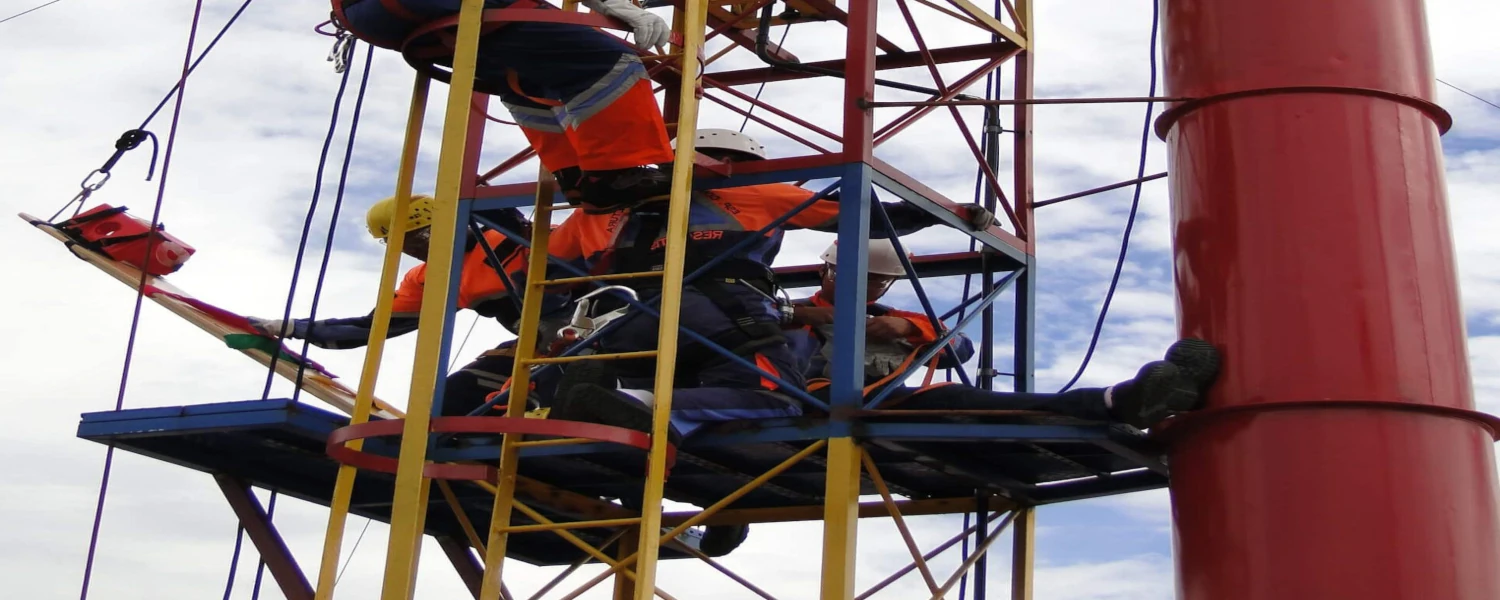
Technical Name: Training Course Leading Technical Rescue in Height and/or Confined Space NR 33 and NR 35 – Intermediate Level NBR 16710
Reference: 171251
We provide courses and training; We carry out Translations and Versions in Technical Language: Portuguese, English, Spanish, French, Italian, Mandarin, German, Russian, Swedish, Dutch, Hindi, Japanese and others consult.
What is the purpose of the Rescue Course Leader?
The Rescue Course Intermediate rescue qualification leader specified for the third level, for which the person is qualified to participate in a variety of rescues at height and/or in confined spaces, at any height level, that require basic movement or displacement of casualties with or without stretchers, using mechanically assembled, prefabricated or pre-molded advantage systems, manual or automatic rescue systems, and mechanical advantage systems, to autonomously access the victim using different rope progression techniques, mechanical systems and electric, specific for moving and rescuing people in all directions.
What is the NBR 16710 recommendation for Leader Level Rescuers?
It is recommended that the leader-level qualified rescuer be a qualified and trained person acting under the coordination of a person responsible for the rescue operation, whose work is carried out in a rescue team with exclusive dedication, as part of the emergency response groups , formed in industries.
OUR DIFFERENTIAL:
(a) The Instructors are Engineers who master the Technical languages in Portuguese, German and English, Mandarin, Spanish, among others with international know-how and active Passports.
We do not work with interpreters, as they are matters of technical engineering levels, their version, interpretation and translation without engineering training can be harmed, inducing serious misunderstandings.
(b) All Professionals have mandatory Occupational Safety Training NR 10, NR 35, NR 33, NR 12, among others, updated and valid.
(c) Upon completion, certificates of participation and achievement will be issued, signed with electronic digital signatures by legally qualified professionals with active CREA:
Work Safety Engineer (Technical Responsible) with active CREA /ART;
Engineer. Electric/Sec. Work (Instructor) with active CREA /ART;
Occupational Physician with active CRM;
Technical Instructor for Fire Fighting, First Aid and Chemical Emergencies;
Click on the Link: Criteria for Issuing Certificates in accordance with the Norms
Treinamento Livre Profissionalizante Noções Básicas (Não substitui Formação Acadêmica ou Ensino Técnico)Certificado de conclusão
Leader Rescue Course
Normative Program Content:
Leader Level:
Official regulatory standards and applicable Brazilian Standards;
Safety principles of a rescue operation;
Identification of the risks associated with a rescue operation;
Risk x benefit assessment in a rescue operation:
Certification of rescue equipment and systems;
Selection and correct use of the following personal rescue equipment:
Parachute belt;
Slings or lanyards;
Connectors and Helmet;
Gloves and Descender;
Elevators;
Fall arresters and stirrup;
Installation and operation of pre-engineered rescue or evacuation systems;
Selection and correct use of the following collective rescue equipment:
anchor ropes, slings, ring, ribbons or beads;
Connectors and Pulleys;
Blockers, stretchers and tripod;
Descenders and elevators;
Assembly of the main stringing nodes used in rescues (blocking, finishing, splicing, anchoring and securing);
Assembly of simple semi-equalized anchors, fractions and deviations with string knots;
Effect of angles formed by anchors on load distribution;
Assembly and operation of simple mechanical advantage systems (block):
Performance limits of rope progression equipment used in victim rescues;
Pre-use and periodic inspections of individual and collective rescue equipment used;
Identification of operational readiness or damage, defects and wear conditions for refusal of equipment that has been disapproved according to the manufacturers’ guidance;
Cleaning methods, packaging and transport of rescue equipment:
Conceptualization of the shock force generated by retaining a fall from a height;
Conceptualization of fall factor;
Knowledge of how inert suspension trauma develops and its main therapeutic measures;
Use of available means of communication, as well as the use of terminology used as standard language for emergencies;
Conceptualization of vertical progression techniques by rope in rescues;
Execution of rope progression techniques in rescues for ascent, descent, passage of fractionations, deviations and knots;
Execution of descent techniques on tensioned ropes;
Execution of progression techniques on horizontal and inclined zip lines;
Use of means of fortune applied to rope rescue techniques;
Execution of rescue techniques with rope progression for descent with victims with passage of fractions, deviations and knots;
Execution of rescue techniques with rope progression to move the victim down or up:
Execution of rescue techniques with rope progression to unlock victims suspended in descenders, lifts or personal fall protection systems;
Different types of vertical transport stretchers, as well as their compatibility with the type of operation or injury of the victim;
Techniques for immobilizing victims on stretchers, with or without the use of spinal or limb immobilizers;
Techniques for vertical movement of victims at height or in confined spaces using pre-engineered rescue and evacuation systems or simple mechanical advantage systems;
Assembly and operation of vertical and horizontal movement systems for stretchers on tensioned ropes (zipline) horizontally and diagonally:
Basic stretcher handling techniques (vertical, horizontal and terrestrial);
Technical factors that affect the efficiency of a rope and/or confined space rescue (eg performance, speed, range, duration, weather conditions, confined space environment, rescuer, etc.);
Techniques for the use of respiratory protective equipment applied in the rescue.
Complements of the Activity – Awareness of the Importance:
APR (Preliminary Risk Analysis);
PE (Emergency Plan);
PGR (Risk Management Plan);
ORM (Occupational Risk Management);
Understanding the need for the Rescue Team – NBR 16710;
The Importance of task knowledge;
Accident prevention and first aid notions;
Fire protection – NBR 14276;
Perception of risks and factors that affect people’s perceptions;
Impact and behavioral factors on safety: Fear factor;
How to discover the fastest and easiest way to develop Skills;
How to control the mind while working;
How to administer and manage working time;
Why balance energy during activity in order to gain productivity;
Consequences of Habituation to Risk;
Causes of accidents at work;
Notions on Tree of Causes;
Understanding about Ergonomics, Workstation Analysis and Ergonomic Risks.
Basic notions of:
HAZCOM – Hazard Communication Standard;
HAZMAT – Hazardous Materials (Hazardous Materials);
HAZWOPER – Hazardous Waste Operations and Emergency Response;
PDCA Cycle (Plan-Do-Check-Act) – ISO 45001;
FMEA – Failure Mode and Effect Analysis;
SFMEA – Service Failure Mode and Effect Analysis;
PFMEA – Process of Failure Mode and Effects Analysis;
DFMEA – Design Failure Mode and Effect Analysis;
Analysis of failure modes, effects and criticality (FMECA);
Bow Tie Tool (Risk Management Process Analysis);
Accident Analysis Tool – TRIPOD Method;
Hazard Communication Standard (HCS (Hazard Communication Standard) – OSHA;
Hawkins Scale (Scale of Awareness);
Practical Exercises:
Registration of Evidences;
Theoretical and Practical Assessment;
Certificate of participation.
NOTE:
We emphasize that the General Normative Programmatic Content of the Course or Training may be changed, updated, adding or deleting items as necessary by our Multidisciplinary Team.
Our Multidisciplinary Team is entitled to update, adjust, change and/or delete items, as well as insert or exclude Rules, Laws, Decrees or technical parameters that they deem applicable, whether related or not, and the Contracting Party is responsible for making the necessary calls. in accordance with the relevant legislation.