Technical Name: NR 12 TRAINING COURSE – SAFETY IN MACHINES AND EQUIPMENT – TAUGHT IN ENGLISH
Reference: 33707
We provide Courses and Training; We perform Technical Language Translations and Versions: Portuguese, English, Spanish, French, Italian, Mandarin, German, Russian, Swedish, Dutch, Hindi, Japanese, and others upon request.
NR 12 Course in English
The NR 12 Course in English trains professionals to work safely and in compliance with NR 12 requirements, with technical mastery of safety demands for machines and equipment, full understanding of technical English, and a focus on preventing mechanical, electrical, and ergonomic accidents.
In addition, the course aims to ensure that operators, technicians, and managers understand and apply standardized procedures, protection devices, risk analyses, and legal responsibilities even in international contexts or multilingual teams, guaranteeing regulatory compliance, operational flow, and globalized safe performance.
What is NR 12 and why is it essential for machine operation safety?
NR 12 is the Brazilian standard that establishes the minimum requirements for preventing accidents involving machines and equipment. It is essential because it mandates the adoption of technical, administrative, and organizational measures that protect workers throughout the entire life cycle of the machine, from installation to decommissioning. The standard creates a preventive culture and strengthens the physical and mental integrity of operators.
When should a company apply the requirements of NR 12?
NR 12 must be implemented from the acquisition of new equipment, through installation, operation, maintenance, and even disposal. Whenever there is mechanical or electrical risk, the standard applies. Additionally, during changes to the factory layout or modernizations, reassessment according to NR 12 is mandatory.
NR 12 Course in English: NR 12 in industrial environments?
It applies to any environment where fixed or mobile machines are present. This includes production lines, maintenance workshops, machining areas, packaging sectors, and even laboratories with mechanical prototypes. Therefore, NR 12 acts as a continuous line of defense in any space with risks of entrapment, cutting, crushing, or electrical contact.
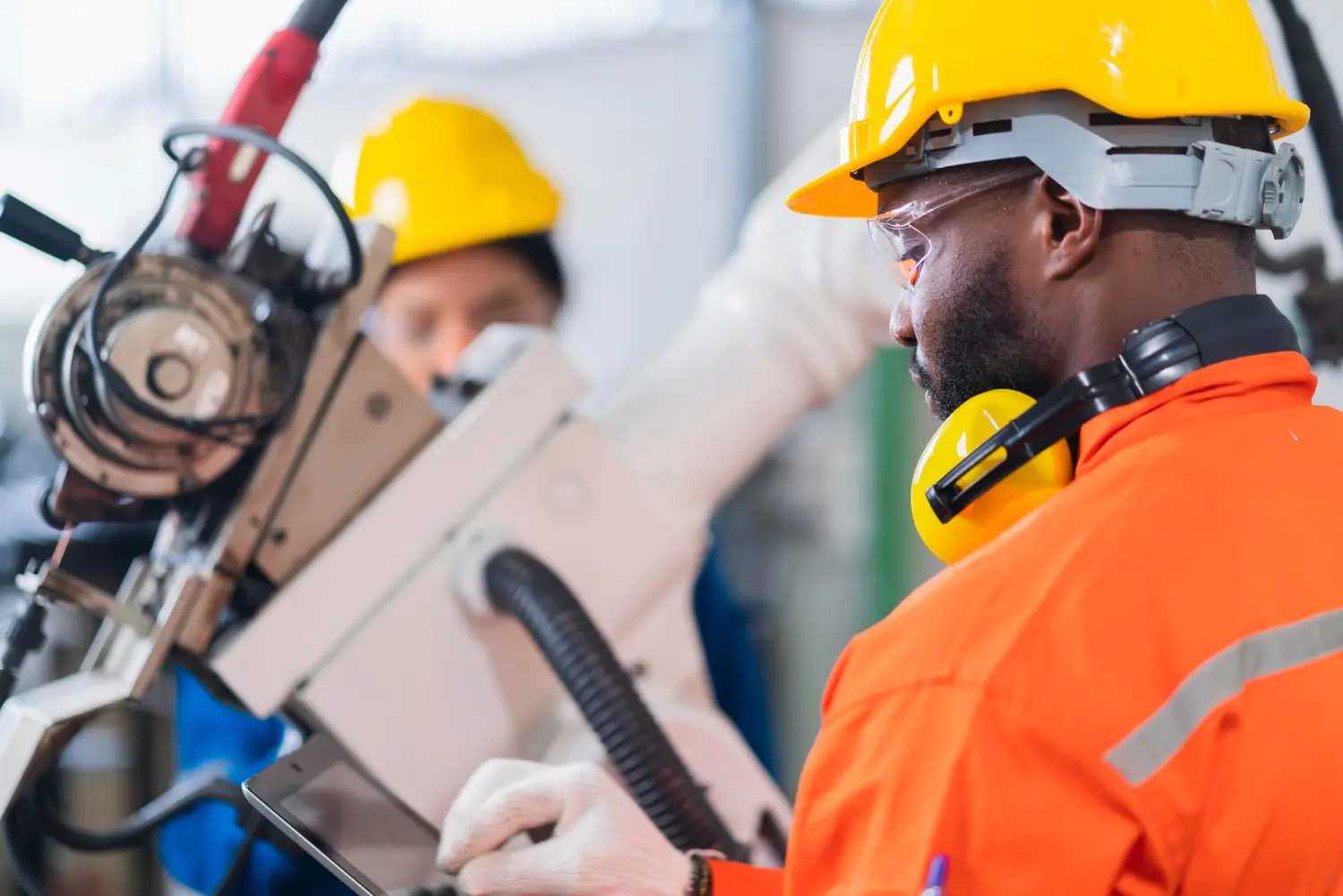
Professional operates machine control system with digital interface, applying NR 12 practices for safety and efficiency in the industrial environment.
How does NR 12 prevent occupational accidents involving machines?
Prevention occurs through the requirement for physical guards, emergency stop devices, lockout systems, and standardized operating procedures. In addition, it requires continuous operator training, periodic inspections, and detailed technical records of interventions, creating an active and responsive safety cycle.
Why is it important to train workers in NR 12 in English?
Training in English is essential in international environments or multinational companies. It ensures that all professionals fully understand the risks and procedures, reducing communication failures and increasing operational effectiveness. Therefore, NR 12 taught in English promotes integration among global teams and ensures compliance even outside Brazilian territory.
Which machines are most critical under NR 12?
Machines with the greatest potential to cause harm, such as presses, injection molding machines, lathes, saws, calenders, and guillotines, are considered critical. For this reason, NR 12 requires individualized risk analysis for these machines, application of specific protections, and technical validation with issuance of ART. The table below illustrates:
| Type of Machine | Main Risk | NR 12 Requirement |
|---|---|---|
| Hydraulic press | Crushing | Two-hand control sensor, light curtain |
| Circular saw | Amputation | Movable guarding, automatic brake |
| Plastic injection machine | Entrapment | Interlocked doors |

Operator controls industrial robotic cell through a digital panel, applying NR 12 requirements for safety in automated machines and equipment.
NR 12 Course in English: How does NR 12 integrate with other safety standards?
NR 12 connects directly with NR 10 (electrical safety), NR 33 (confined space), NR 35 (work at height), and NR 01 (risk management). In addition, it is aligned with international standards such as ISO 12100 (machine safety) and ISO 45001 (OHS management), creating a robust regulatory network. This integration enhances governance and reduces legal and operational vulnerabilities.
Who is the NR 12 Course in English recommended for?
The course is recommended for technicians, engineers, supervisors, machine operators, and managers who work in environments with international influence or who receive audits from foreign clients. It is also suitable for companies with branches or projects abroad, where bilingual training becomes a technical and commercial advantage.
Click the Link: Criteria for Issuing Certificates according to the Standards
Professional Free Training – Basic Concepts (Does not replace Academic Education or Technical Training)
Certificate of completion
NR 12 Course in English
TRAINING COURSE NR 12 – SAFETY IN MACHINES AND EQUIPMENT – TAUGHT IN ENGLISH
Workload: 16 Hours
Module 1 – Introduction to Safety in Machines and Equipment (2 HOURS)
Concept of safety in machine operation: risk perception and prevention culture
Typical accidents and organizational impacts
Types of mechanical, electrical, thermal, and ergonomic risks
Human behavior in the face of automation
Clear communication as a safety tool
Module 2 – Risk Identification and Generating Sources (2 HOURS)
Entrapment, cutting, impact, and shearing zones
Practical analysis of hazards in fixed and mobile machines
Visual and sensory techniques for risk detection
Evaluation of machine cycle and behavior in failure
Application of corrective measures focusing on imminent risk
Module 3 – Safety Devices and Guards (2 HOURS)
Types of physical guards: fixed, movable, adjustable
Interlocking, sensors, light curtains, and emergency stops
Symbolic barriers and dual controls
Integration between protection and productivity
Practical cases: circular saw, lathe, press, calender
Module 4 – Safe Operating Procedures (2 HOURS)
Start-up and shutdown sequence with risk control
Lockout and release procedures for maintenance
Planned shutdown sequence and residual energies
Safety checklists and operation validation
Individual and collective responsibilities
Module 5 – Inspection, Adjustment, and Technical Interventions (2 HOURS)
Scheduled and emergency interventions
Technical adjustments with the machine stopped and energized
Communication between technical and operational sectors
Traceability of actions and records
Principles of operational reliability and safe performance
Module 6 – Safety Management and Machine Documentation (2 HOURS)
Machine survey and simplified technical inventory
Identification of critical points and risk records
Updating layouts, flows, and signage
Action plan based on real priorities
Machine documentation as a tool for continuous management
Module 7 – Human Behavior and Safe Decision-Making (2 HOURS)
Human factors: fatigue, habit, distraction, and overconfidence
Decision-making under risk: pressure vs. safety
Situational awareness and early failure perception
Micro-behaviors that prevent accidents
Real cases and applied behavioral analysis
Module 8 – Simulation, Diagnosis, and Best Practices (2 HOURS)
Simulation of failures, maintenance, and operational restart
Technical-behavioral diagnosis with practical application
Examples of machines according to criticality and complexity
Best practices in the production routine focusing on zero accidents
Closing with an individual and collective action plan
NOTE:
We emphasize that the General Normative Program Content of the Course or Training may be changed, updated, with items added or removed as necessary by our Multidisciplinary Team. Our Multidisciplinary Team is authorized to update, adjust, modify and/or remove items, as well as insert or remove Standards, Laws, Decrees, or technical parameters they deem applicable, whether related or not, and the Contracting Party is responsible for complying with the requirements established by the pertinent Legislation.
NR 12 Course in English